Showing posts with label Easter. Show all posts

Sunday, 16 April 2017

Mary Magdalene: The Beloved of The Beloved


Give therefore your hearts and your souls, to seek the Lord your God
(1 Chronicles 22:19)

At His appearance by the Sea of Tiberias there is one Apostle who recognises the Risen Christ ahead of all the others 'That disciple therefore whom Jesus loved, said to Peter: It is the Lord' (John 21:7) Quick-eyed love is more clear sighted and faster to apprehend than any other of the senses when it comes to the beloved object.

Although the Evangelist talks of the love that Jesus had for the disciple not of the disciple's love for his Lord there can be no doubt that it was a mutual relationship. God loves each of us infinitely but we experience that divine hunger for us in different degrees according to what is in our own soul. The powerfully felt and strongly expressed love of St John for the Christ called forth such a strong response from Jesus that His love for the Apostle was apparent to all.

The same principle was at work in the events of the first Easter morning. Mary Magdalene became witness to the Resurrection and Apostle to the Apostles because her passionate and chaste devotion to Him drew her to seek Jesus and drew Him to show Himself to her. 'For thee my flesh and my heart hath fainted away: thou art the God of my heart' the psalmist had said (Psalm 72:26) and the Magdalene lived these words with her entire being.

Tradition has applied to her the words 'Many sins are forgiven her, because she hath loved much.' (Luke 7:47) and also ' Mary therefore took a pound of ointment of right spikenard, of great price, and anointed the feet of Jesus, and wiped his feet with her hair' (John 12:3) Modern scholars question this interpretation of the texts but the Christian ancients intuited a great truth which academics don't concern themselves with. That is, Mary Magdalene received the unique privilege of becoming the first recorded witness to the Resurrection not by happy chance but because her consuming, burning, fiery love for Jesus the Saviour gave her the position of first among equals of all those who had come to know Him since His Nativity.

This bright love,though, has its dark places. The Magdalene came to the joy of the Risen life by travelling through the valley of the shadow of death. Because she loved so much she suffered enormously on the hill of Calvary when her beloved had died an agonising and shameful death. Long and dreary too were the bleak hours that passed between His entombment and that moment 'very early in the morning, the first day of the week' (Mark 16:2) when she became the glad bearer of Good News that the world had changed forever. She bears witness too that for all of us however close we may be to the Lord (or think ourselves to be) there will be no Crown if there has been no Cross.
@stevhep

Catholic Scot has a Facebook page.

My *other* blog is thoughtfully detached

The picture is Noli Me Tangere from a 15th Century Paris Missal.

Monday, 4 April 2016

Mary and the Word of God


The word that goes from my mouth does not return to me empty, without carrying out my will and succeeding in what it was sent to do
Isaiah 55:11

And Mary said: Behold the handmaid of the Lord; be it done to me according to thy word
Luke 1:38

When the Solemnity of the Annunciation coincides with Eastertide it invites us to consider the great mysteries together. Pre-eminently the Word of the Father is the Son. That Son went forth from the mouth of the Father and became clothed in flesh the moment our Lady gave her glad consent. Before, at the Ascension, He returned to His source the Word experienced the flight into Egypt, the hidden life in Nazareth, the mission in Galilee, the betrayal, abandonment, torture and death of the Passion and the Easter resurrection. All of which constituted, as Isaiah foresaw, a carrying out of the will of the Father, voluntarily undertaken, and an achievement of His purposes using the weapons of humility and seeming defeat.

This all was the work of the Triune God Himself. Father, Son and Holy Spirit are each involved essentially in everything that makes for Man's liberation from the dominion of darkness. It has never been, however, God's way with His free creatures, Men and Angels, to act alone, without their participation in their own emancipation. Before the Son, as Man, could begin to do the will of the Father on earth Mary, as Woman and as our representative, had first to make that precise same choice- voluntary obedience to the Father's will.

The glorious triumph of Easter, then, is radically dependent on the quiet faithfulness of Mary. The work of the Word on earth, in the person of Jesus, is God's will in action. This is an exercise of power which is not imposed upon humans but which comes about through His co-operation with them. It is, to be sure, not a relationship of equals, the distance between God and Man is always infinite except in the God Man Jesus. Nonetheless it is a necessity for the God who *is* Love to act in ways which are true to His essential nature and that includes respecting the freedom of those whom He has created to be free. In Measure for Measure Isabella says-
O, it is excellent
To have a giant's strength; but it is tyrannous
To use it like a giant. 
The Lord God is no tyrant therefore He uses His strength with restraint and as a Father not like the pagan gods who were understood to be capricious, deceitful and without restraint of any kind save that imposed by other gods.

It is because God's nature makes human co-operation a necessity for human redemption to be achieved that we can speak of the particular human, Mary, whose co-operation was most necessary as a co-redeemer with Jesus. There is of course only one redeemer, Jesus, and one redemption, through His crucifixion and death, yet without Mary's fiat mihi there would have been no flight into Egypt, no hidden years in Jerusalem and, above all, no Passion, Death and Resurrection. The Father's Word went forth and returned successful not only because it was spoken by Him but also, and crucially, because it was heard and listened to by the Blessed Virgin Mary.

@stevhep

Like the Catholic Scot Facebook Page

The painting is from The Life of the Virgin-The Annunciation by Vittore Carpaccio 


Tuesday, 8 March 2016

Out of the Silence


The use of perspective in painting means that one can stand very close to an object yet have the illusion that it is in the far distance. Religious believers often experience something of the kind in their relationship with the Divine One. Faith informs us that He is near at hand, within and without, yet our senses, our emotions our intellect cannot detect Him. "If He is silent and deaf then it is the same as if He did not exist" a little voice whispers to us.

This experience of His absence could, on the one hand, lead us to abandon faith altogether or else it might teach us patience. It sometimes happens that when people ask me something I spend some time thinking before I answer. Often the questioner will repeat the question or move on to some other topic before I start speaking. The expectation is that conversation should have no pauses and when they occur they should be skated over as quickly as possible. Why should this be so though? There is no objective reason why speech should always take priority over thought, indeed the very opposite might be argued to be the case in many situations.

Naturally you can guess where I am going with this. If silence is not evidence that a conversation is at an end then neither is absence evidence of non-existence. The silence of God, who is love, must necessarily be a loving silence. He does not need time to think but we often need time to be made ready to listen attentively and to hear clearly.

Every year the Church offers us the season of Lent as a desert experience. We do without things which normally accompany us and we wait for the great transformation of the world which Easter will effect. It is an opportunity for us to change our own perspectives. Not, here, as an artistic technique but rather as the ground upon which we stand when we survey all that is around us. It is a time to experience silence and loss and desolation confident in the knowledge that it will be followed by a resurrection, a triumphing of light over darkness.

The silence of the God who is near at hand is not a rejection. It is an invitation. Our task is to see it, to recognise it and to accept it.

Follow @stevhep on Twitter

Like the Catholic Scot Page on Facebook

The painting is Landscape with Hagar and the Angel by Claude GellĂ©e


Saturday, 30 August 2014

And It Was Night


                                                           Last Supper- Perugino

After receiving the piece of bread, he went out immediately. And it was night.
John 13:30

The Gospel account given by St John in large part consists of long periods of dialogue interspersed by short narrative sections. It is tempting to consider those sections are simply being bridges leading from one conversation to another put in merely to give some context. As I have mentioned in some of my earlier posts, however, St John's is the most highly structured of all the Gospel accounts and every word usually does duty at more than one level. If we spend time meditating on these narrative passages we can see that each of them carries more meaning than may at first appear and serves the Evangelist's didactic purposes as much as any other part of the Gospel. And so it is with this record of the last few moments that the traitor Judas Iscariot spent in the friendly company of the Apostles. When next they met it would be as enemies.

We can conveniently divide this into three sections beginning with Jesus handing some bread to Judas. The concept of bread is central to the Christian project. It is widely thought, for example, that the chief significance of the birth of our Lord at Bethlehem is that it was a fulfilment of Old Testament prophecy. So much so indeed that atheist and theologically liberal critics suggest that St Matthew and St Luke fabricated their accounts of the Nativity in order to fit in with this preordained schema. The name Bethlehem, however, means 'house of bread.' So we can say that Divine Providence achieved a double whammy by ensuring that Jesus was born in a place which both looked back to historical prophecy and looked forward to His own mission.

Earlier in the Gospel the Christ describes Himself in this way I am the bread of life (John 6:35) and He also said  Don’t work for the food that perishes but for the food that lasts for eternal life, which the Son of Man will give you (John 6:26) As the other Evangelists tell us previously in this same meal He had shown what He meant And He took bread, gave thanks, broke it, gave it to them, and said, “This is My body, which is given for you" (Luke 22:19) So, what we see in this segment of narrative is Judas accepting the food that perishes as his portion when he could have instead accepted the food that lasts for eternal life. It is customary to think of thirty pieces of silver as the price for which he sold the Saviour but St John illustrates here that it was even less than that. Other translations refer to this piece of bread as a 'morsel' or a 'sop'. It was a mere nothing and he preferred that to everything. He was betraying himself as surely as he was betraying our Lord. To add to the burden of his folly and sin he had earlier participated in the Eucharist so that he received the sacred elements of communion falsely and now took what was the object of his real desires, that is the purely carnal, material rewards that an unspiritual life offers.

He went out immediately. There is no gap between a decisive act of the will and its spiritual and moral consequences. We can see this at what you might call both the other end of the Gospel and the other end of the moral universe where the immediate consequence of Mary saying Behold, I am the handmaid of the Lord. May it be done to me according to your word.” (Luke 1:38) is that she conceives with joy Jesus in her heart before she does so in her body. Here Judas has reached the crucial point. He could have gone back on his agreement with the High Priest. His heart could have been softened by this shared banquet with our Lord and His friends. But now he made the final step within himself. He took the bread that perishes and with it he perished himself, all the rest was just an acting out in the physical realm a destruction which he had taken upon himself in the spiritual one. It reminds us that in Genesis God had said to Adam and Eve of the tree of the knowledge of good and evil you shall not eat, for in the day that you eat of it you shall die (Genesis 2:17) The story tells us that the pair lived for many years after they had eaten of that fruit but the Almighty had spoken truly since death entered their souls from the moment that they decided to eat from this tree.

As a completely random aside, the fruit that Adam and Eve ate is generally depicted to be an apple. This puzzles many people since the item in question is never named and it wouldn't necessarily be the first thing you would think of as a Middle Eastern fruit. My guess is that the idea stems from this passage in the Song of Songs Under the apple tree I raised thee up: there thy mother was corrupted (Song 8:5) Interpreting the Song allegorically was a small industry in Medieval times since obviously it's not the erotic poetry it might appear to be. Here the soul of the believer or humanity in general is raised up by Jesus from the corruption inherited from our first parents. And since the corruption took place under an apple tree the agent of corruption must have been an apple QED.


And it was night. St John is not simply acting as a speaking clock here. As death had entered the soul of Judas, both his own and that of his Master, he plunged into deep gloom. This is your hour, and the power of darkness (Luke 22:53 For our wrestling is not against flesh and blood; but against principalities and power, against the rulers of the world of this darkness  (Ephesians 6:12) Jesus had said of Himself I am the light of the world. Whoever follows me will not walk in darkness, but will have the light of life.” (John 8:12) Judas by walking out with murder in his heart left behind the light and found only darkness within and without. Whoever walks in the dark does not know where he is going. (John 12:35)

Looking at the passage as a whole then. We can see that the bread of life, both spiritual and material, comes to us from the hand of God. If we accept only the material we die spiritually. If we accept only the spiritual we would die physically. With gladness and thanks we should accept all that the Lord gives us in order to live fully. More than that 'He gives' and that sets us an example, if we have received an abundance of His gifts then it behoves us also to give, to act as His agents. If we hoard material wealth we resemble Judas, if we give it away we resemble Jesus. If we refuse to accept His gifts then we immediately banish ourselves from His presence. But why would we? Why did Judas? Material things are tangible, we can see them, touch them, use them to satisfy our physical desires. Spiritual things are invisible, sometimes we can be aware of their presence but often enough they are like a seed hidden in the soil, it may be growing and preparing to bear abundant fruit but we are unaware, other than by faith, that this is so. You need neither faith nor love to use physical objects, you need both to fully respond to the spiritual gifts that come to us from Christ Jesus. And finally night is the natural home for those who are satisfied only with the things of death. And this is the verdict, that the light came into the world, but people preferred darkness to light, because their works were evil. For everyone who does wicked things hates the light and does not come toward the light, so that his works might not be exposed. (John 3:19-20)  

         
Follow @stevhep on Twitter, Google+ and Tumblr. Follow Catholic Scot on Pinterest. Like the Catholic Scot Blog Page on Facebook.


Saturday, 14 June 2014

Christ Riding Into Jerusalem- A Poem


It was a triumph, of sorts.
A great rejoicing that bright day.
Under the sun that too soon set.

Beneath Him a colt, patient

And willing, itself a parable
For those, those few, who heed such things.

Pilgrims without pilgrim hearts

They thought that they had arrived
But pilgrimage never ceases.

City dwellers scorned these

Uncouth travellers, amused
And puzzled by their cries.

Son of David from Nazareth?

A small town Messiah for
Small town people.
Jerusalem knows better.

Palms in His path, tales and

Rumours of miracles in the air
And hopes of war and battle in
Minds of a conquered people.

His name was on every tongue

As He was on His colt
And the beast was wiser than the men.

In Bethany He had been anointed

For His death but who, in this mad crowd
Remembered that? Conquering
He would conquer. 

Victory Hosannas would soon be heard

So they supposed who saw their humble, 
Prophesied King.

In all that joyful throng, that joyful day,

Who could foresee that a victory cry
Would strangely resemble the weeping
Of a mother cradling her dear Son's corpse? 

Follow @stevhep on Twitter, Google+ and Tumblr. Follow Catholic Scot on Pinterest 


Sunday, 20 April 2014

Monday, 8 April 2013

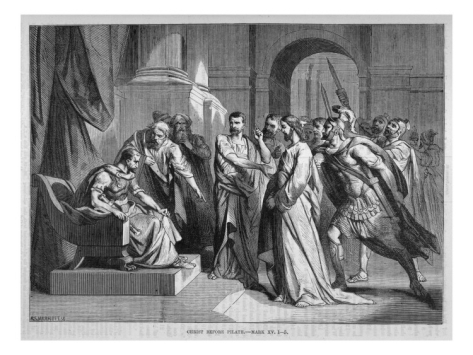
The Seven Questions of Pontius Pilate


Are you the King of the Jews?

Am I a Jew?

What have you done?

So you are a king?

What is truth?

Where are you from?

Do you not know that I have power to release you, and power to crucify you?

(John 18 and 19 RSV)

In his account of the dialogue between our Lord and his judge St John the Theologian puts a number of questions into the mouth of Pilate. The Roman Governor is, in fact, one of the very few gentiles with an extended role in the Gospel accounts. Here, perhaps, St John conscious that most of his audience were also gentiles makes Pilate their representative. The questions he asks are important not simply in the context of the Passion but also they are important for us. They go the the heart of who Jesus is and why He matters to the world.

Is Jesus the Messiah, the Anointed one of God, for whom the Jews had long been waiting in in whom they vested such high hopes? If He was then it would follow that Jewish prophecy was founded on the truth that there was, and is, One God who intervenes in human history and has revealed Himself through a covenant relationship with the children of Abraham, Isaac and Jacob. Jesus did not answer Pilate directly but readers of the Theologian would recall His dialogue with another gentile in Samaria-

25 The woman said to him, “I know that Messiah is coming (he who is called Christ); when he comes, he will show us all things.” 26 Jesus said to her, “I who speak to you am he.”
John 4

Does this matter to non-Jews? Very much so. If there is but one God, Father, Creator and sustainer of all that is, then His interventions into human history have a purpose which we would do well to heed. In a sense we are all Jews now. The Messiah has opened the doors into the people of God to all who are the children of Abraham, Isaac and Jacob by faith and not simply by blood. Or, more precisely, we are children through the blood of Christ rather than the blood of Abraham. And being made members of God's household we obtain new privileges and duties.

What had Jesus done? Speaking to a household of gentiles St Peter described His actions in this way-

God anointed Jesus of Nazareth with the Holy Spirit and with power; how he went about doing good and healing all that were oppressed by the devil, for God was with him
 Acts 10

But the High Priestly party described them very differently-

47 So the chief priests and the Pharisees gathered the council, and said, “What are we to do? For this man performs many signs. 48 If we let him go on thus, every one will believe in him, and the Romans will come and destroy both our holy place and our nation.”
John 11

The key difference was that the Apostles saw the power of God acting through our Lord guaranteeing the success of His mission. albeit in ways they did not foresee. The Jerusalem authorities saw the power but doubted the source. For them He was only a man and Rome was greater than Him. In Him the Apostles hoped and because of Him the Sanhedrin feared.

Was Jesus a King? He was, and is, the author of all kingship yet His own authority is both vastly more and vastly less than that which we usually attribute to our earthly rulers be they Princes or Presidents. Less because He is the one who washes our feet and takes our stripes for us. More because-

25 Of old thou didst lay the foundation of the earth,
    and the heavens are the work of thy hands.
26 They will perish, but thou dost endure;
    they will all wear out like a garment.
Thou changest them like raiment, and they pass away;
27     but thou art the same, and thy years have no end.
Psalm 102

The interesting thing about the question "What is truth?" is that having asked it Pilate left without waiting for an answer. In that, surely, he is a representative figure for all of us. He knew that this was perhaps the most important question of all. He knew also that he was in the presence of one who could answer that question. Yet the pressures of the world and its demands upon him took priority. He left Jesus in order to stop being ignorant in the presence of knowledge and start being powerful in the presence of those subject to him. God reveals Himself to those who listen. Some listen not at all, some but seldom and very few listen with all their being all the time. In this Pilate reveals what we are and the Blessed Virgin Mary shows what we should be.

Where have you come from? An important question for Jew and gentile alike.
Yet we know where this man comes from; and when the Christ appears, no one will know where he comes from.
John 7
To which He replied-
You know me, and you know where I come from? But I have not come of my own accord; he who sent me is true, and him you do not know.29 I know him, for I come from him, and he sent me.
John 7
To Pilate He gave no reply which conveyed precisely the same amount of information as His answer in the Temple did. He was called a Galilean and a Nazarene. We are told that He was born in Bethlehem. None of this tells us where He came from. Only Gabriel told this and only Mary heard it

“The Holy Spirit will come upon you,
and the power of the Most High will overshadow you;
therefore the child to be born will be called holy,
the Son of God.
Luke 1

The seventh question is clear. Man tells God that we have power over Him. The same assumption made in Eden is now made in the Praetorium and, perhaps, within your heart and mine. We can take up and put down Jesus as and when we want in the measure that we want. The power is ours.Yet Pilate was mistaken, the High Priest was mistaken. And you? Are you in error too?

Follow me on Twitter @ https://twitter.com/stevhep


Monday, 18 March 2013

A Death Must Follow, Palm Sunday Reflections


15 Thus, through his intervention, a new covenant has been bequeathed to us; a death must follow, to atone for all our transgressions under the old covenant, and then the destined heirs were to obtain, for ever, their promised inheritance. 16 Where a bequest is concerned, the death of the testator must needs play its part; 17 a will has no force while the testator is alive, and only comes into force with death

Hebrews 9

For those joyful pilgrims to Jerusalem who welcomed Jesus with such exuberance there was no thought of death. They believed, and rightly believed, that the path before His feet and theirs was the fulfilment of the promises of God, the glory and triumph of the heir of King David over His deadliest and most intransigent foes. They were right in their choice of a Champion of their cause. They were wrong in assuming that they knew who the enemy was and what was the weapon that would defeat him.

It was not Rome or the High Priestly party at whom Jesus aimed. It was at death and the power of death. And His weapons were submission, defeat and an agonising passing into the shadow of destruction. The ending of life and with it the apparent dashing of His hopes and those of His followers, the joyful, exuberant, hopeful pilgrims scattered and despairing, sheep without a shepherd.

In the day of optimism all surely remembered the words of Zecariah See where thy king comes to greet thee, a trusty deliverer; see how lowly he rides, mounted on an ass, patient colt of patient dam! Our Lord knew, if no one else did, that lowliness was not a cloak which He was about to cast off as He gloriously led an army to victory. Lowliness, humility, was not with Him a state of mind which could come and go. It was an essence, not an accident, of His nature. And to be true to Himself it could only be in and through and with this essential characteristic that He would fight His battle, secure His triumph and bequeath His inheritance to those who believed in Him. Jesus Christ, the same yesterday, today and forever.

Though these Palm Sunday crowds could not foresee the future nor as yet understand their Messiah and His purposes they were not wrong to rejoice. They thought that their case was that of the Psalm 12 Word has come from the Lord, good news borne on a multitude of lips: 13 Routed their kings, routed the armies; they have left their spoils for housewives to carry away; 14 never shone silver so bright on a dove’s feathers, never gold so fair on a dove’s wings; and you, all the while, resting quiet among the sheep-folds! And so indeed it was. But they gained their share of the spoils as legatees, inheritors of a Testament, not as warriors and their camp followers.

It was the way then, as it often is now, that adherents of religion mix their material desires with their spiritual in a confusion of hopes and fancies not without a hint of greed for possession and prestige. Palm Sunday should teach us that if we hope in Jesus we do rightly especially when we recall that a death must follow. Upon that death we must stake our lives. And the Kingdom we shall enter into is not of this world.

https://twitter.com/stevhep

http://www.facebook.com/CatholicScotBlog