Showing posts with label Christmas. Show all posts

Thursday, 31 December 2015

Forty Joyful Days


St Luke tells us about three significant forty-day periods in the life of our Lord. These are:
  • the time between the Nativity and the Presentation in the Temple (Luke 2:22)
  • the time that Jesus spent in the desert after His baptism (Luke 4:1-2)
  • the time between the Passion and the Ascension of our Lord (Acts 1:3)
It would seem to be the case that the period in the wilderness was a necessary final preparation before the Messiah began His mission and that the period after the resurrection was a necessary final preparation before the Apostles undertook their mission, to proclaim the Good News to the world. I would argue that the first period constituted a necessary preparation for Mary before she undertook her mission as the Mother of God present in the flesh, Emmanuel, God with us.

The forty-days had an explicitly Marian dimension in that they constituted the time required for Mary to purify herself, according to the Law of Moses, after the birth of a son. Of course strictly speaking she could have dispensed with the requirement (as her Son could have done with circumcision on the eighth day) because the Law was only the shadow of things to come (Colossians 2:16-17) and the reality had now come in the form of the infant Christ. However since He was born of a woman, born under the Law (Galatians 4:4) it was seemly that the provisions of the Law should be adhered to until our Lord completed His mission on the cross at Calvary.

These days, though, were much more than the formal keeping of an outward legal prescription. They were a time of great and never to be repeated joy for the Blessed Virgin. Mary had a life full of sorrow and trouble. From the Annunciation to the first Christmas she had all the anxieties of any pregnancy plus the peculiar difficulties attendant on being the unique virgin mother-to-be of the Son of God. She also had the pain of inflicting pain upon St Joseph by her silence about the conception until an angel enlightened him about it. Furthermore she undertook three long journeys during this time, those to and from St Elizabeth and finally the trip to Bethlehem while nine-months pregnant which ended in the worry about finding somewhere to stay while she give birth.

During the Presentation Simeon prophesied that she would have her soul pierced by a sword (Luke 2:34-25) although there is no doubt that she was more concerned that he also foresaw that her Son would be a sign of contradiction and thus experience in Himself a turbulent life. The shadow which descended upon her at these words would never afterwards depart from her until all was fulfilled. And then, shortly afterwards, she and St Joseph had to escape form the Holy Land altogether and seek refuge in far-off and alien Egypt.

Mary, though, was blessed with these forty tranquil, trouble-free, joyous days with her Son and the holy patriarch. It was a time to bond with Him. To gaze her fill upon Him with the eyes of a mother and of a daughter of God. He was blood of her blood and flesh of her flesh and nourished wholly by the milk of her own body. There were no clouds in the sky. She could reflect with gladness and hope on the words of the archangel Gabriel "He shall be great, and shall be called the Son of the most High; and the Lord God shall give unto him the throne of David his father; and he shall reign in the house of Jacob for ever. And of his kingdom there shall be no end." (Luke 1:32-33) And on those of the angel to the shepherds "I bring you good tidings of great joy, that shall be to all the people" (Luke 2:10)


The relationship between our Lord and our Lady that was so close and that endured so much had begun in her womb and continued long after these days but this period was special. For the first time they could see each other and Mary could express her love through the simple, practical actions of the body which are so human and so necessary. To kiss her child, to hold Him in her arms, to see Him sleep, to lie still and hear Him breathe, to feed Him and bathe Him, to smile at Him, perhaps to shed tears of pure happiness over Him. These were the things that transformed Mary into the woman who would be able to do and suffer all that she would subsequently be called upon to endure for the cause of the Redemption wrought for us all by her Jesus.

Luke repeatedly tells us that Mary treasures the things of Jesus in her heart and ponders upon them. This is of twofold importance for these forty-days. Firstly, during that time she could call into her heart the love and mercy of God towards her, her people Israel and all the world and link it to the child whom she was just beginning to know. Secondly, in the long, dark and troubled years to follow she could summon up the spirit of these days to console and strengthen her. This would be no nostalgia for better times but an actual making present within herself of the incarnated love which having been begun in the world and in her inmost being would never pass out of them though they would sometimes be hidden. And this is what makes these days important for us too. We can not only rejoice with Mary's rejoicing but we can imitate her. In our moments of trial we, by contemplating the life of our Lord and recalling our personal moments of grace can bring them to life because they are moments of eternity which have intersected with time. In prayer and thankfulness we, like our Lady, can find the key that lets light into our darkness because we too can adore her Son any time we want to.
@stevhep


My other blog is thoughtfully detached

The paintings are The Holy Family-the workshop of Raphael and The Holy Family- Joos van Cleve


Friday, 25 December 2015

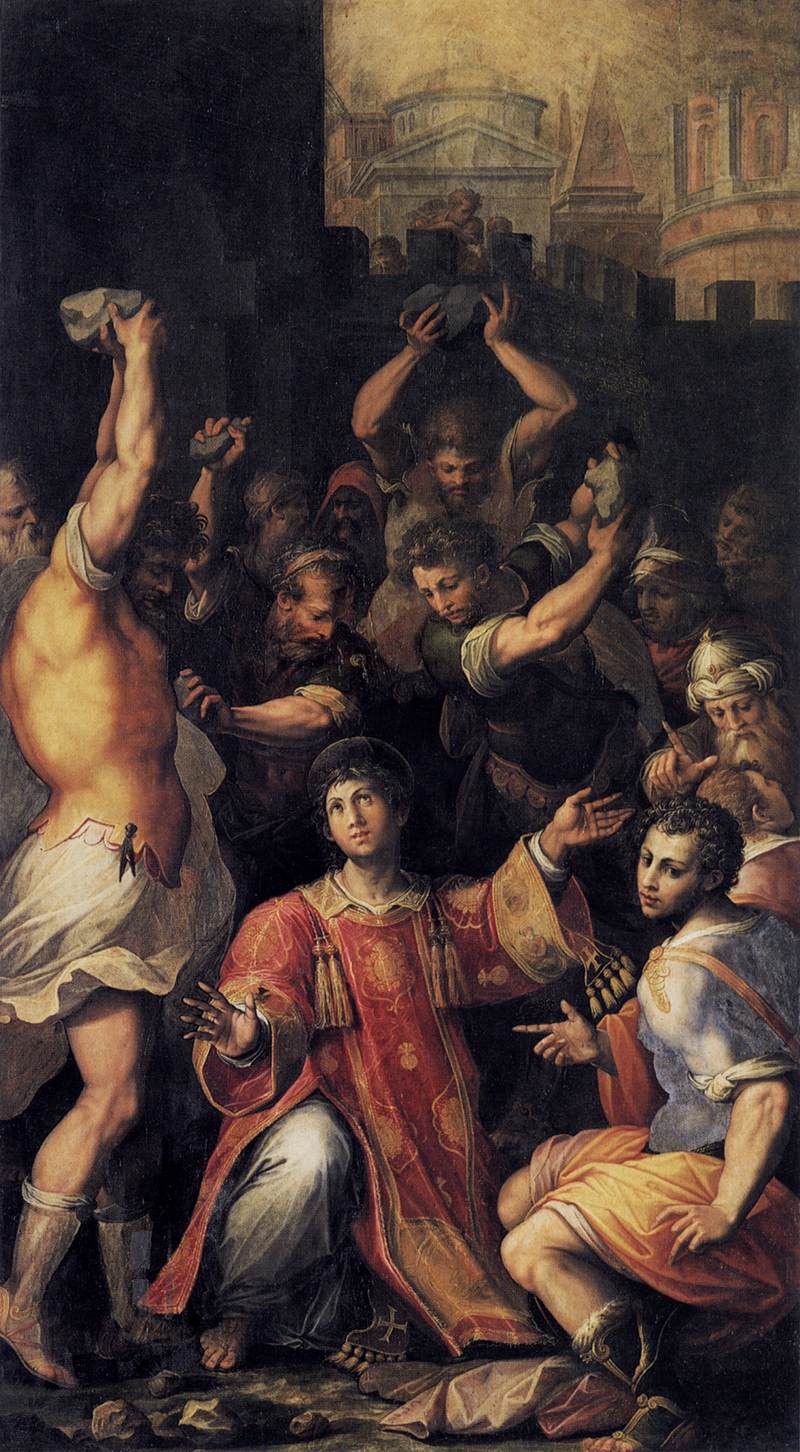
On the Feast of Stephen

Giorgio Vasari Martyrdom of St Stephen.jpg
The birthday of the Christ child was an event of joy for each person involved in it, as it has been for Christians ever since. Yet it was a joy hedged about with anxieties. The Magi may have had to resort to people smugglers to escape from Palestine. The Holy Family were forced to seek asylum in Egypt. The infants of Bethlehem were massacred by the security services of a paranoid Middle-Eastern despot. It is no accident, then, that Holy Church has twinned the celebration of Christmas on the 25th with that of the first Christian martyr, St Stephen, on the 26th of December.

You do not have to be religious, of course, to appreciate the fragility of human happiness. In these days we are remembering the centenary of the First World War. There were many thousands of births in Cowley or Cologne, Dublin or Delhi, where unfeigned rejoicing was tempered by fear that the fathers of the babies would never live to see them. Weddings too were celebrated in the shadow of barbed wire and poison gas.

We are powerfully tempted to use magic to banish painful memories and anticipations from our thoughts. Not just the magic of spells and charms but that of money or power or alcohol or chocolate. Anything indeed that can keep an illusion of permanent happiness present within us. Since we know deep down, however, that none of this magic really works we are forever engaged in a restless search for new charms or more supercharged versions of current ones.

The genius of Christianity is not that it enables us to escape suffering (which is the false promise of magic) but that it brings hope into the midst of even the worst of our torments. St Stephen on trial for his life was transfigured not by fear but by the Holy Spirit “All those who sat in the Sanhedrin looked intently at him and saw that his face was like the face of an angel.(Acts 6:15) As he met his violent death he could say “Behold, I see the heavens opened and the Son of Man standing at the right hand of God.” (Acts 7:56)

This is not a compulsory and artificial cheerfulness, many Christians suffer from the effects of depression or anxiety. It is not the least of the fruits of the Incarnation that God Himself is our companion both in our times of greatest rejoicing and those of our greatest suffering because they are no more alien to Him than they are to us. The gift of a living faith is that we possess the knowledge that we are never alone (except when we sin.) That knowledge born into the world on the first Christmas morning accompanied St Stephen as the murderous fury of a mob vented itself upon Him.

The martyred Saint, like the child born on Christmas day, was an innocent victim of unjust persecution. Being a Christian in the world can bring down more suffering upon us than if we were not Christians. In many places today this is suffering of a kind which Jesus and St Stephen could readily recognise. In the West such persecution is, for the time being at least, not experienced and there is little more than ridicule, insult and exclusion to fear. Even so why should we take this extra cross upon ourselves? Pope St John Paul II once said “Christianity is not an opinion nor does it consist of empty words. Christianity is Christ!” (World Youth Day 2003.) We have no reason to celebrate the coming of the Christ child into the world if we do not also welcome Him into our hearts. His presence there is that knowledge which enables us to more than endure the sufferings we cannot escape. It is also the sign of contradiction which challenges not only our own faith in magic but that of others. We cannot escape our own illusions without also offending those who cling to theirs. The boy born that first Christmas would one day say “If the world hates you, realize that it hated me first.” (John 15:18)

If, however, you do bear Christ within you then you carry a love that cries out to be shared. You can share it by your words and by your actions and these can persuade friends. To persuade enemies you need something stronger yet. The Church Father Tertullian said  "the blood of martyrs is the seed of the Church." Living in a country where you are not likely to die for your faith does not deny you the opportunity to make the same witness. In 1914 and 1915, no doubt, there were many people who joined the armed forces because they feared the shame of being called a coward more than they feared the trenches of Flanders or the cold waters of the Atlantic. In a sense conscientious objectors showed at least as much courage by standing against the mentality of the day as those who signed up for fear of ridicule (which is not to denigrate the courage of the many who joined up fully conscious of the risks.) For us the challenge is to say ‘Yes, we really do believe “all that stuff” however absurd it makes us appear to you and that is why we are willing to welcome refugees, to visit prisoners, to speak kindly of enemies, to reject the magic of power and money.’ And that is why, like St Stephen, we too can hope to see the heavens opened and the Son of Man standing at the right hand of God.
@stevhep

My other blog is thoughtfully detached

(the painting is the Martyrdom of St Stephen by Vasari)


Tuesday, 15 December 2015

Rabbi Koala & the Christ Child-A Christmas Fable


My life, now drawing towards its end, has been long and full of incident. I had intended to leave a record outlining all the extraordinary events which have led me to become the only koala bear in the Holy Land and a Rabbi in the Synagogue of the Creatures. Writing books, as you know, is a difficult task for animals and it took much effort and planning to obtain all the materials needed to write my account. I had only just succeeded in gathering them all together when incredibly, wonderfully, miraculously I encountered the long awaited child of promise. Laying aside then, with some regret, all my plans I will instead tell you about this, the single most important thing which has ever happened to me.

Because of my unusual history (which, alas, I will never now record) I have particular responsibility for providing pastoral care to migrant animals in what the Romans call Palestine. Most of these are congregated in the capital city, Jerusalem, so I am based there but every year I make a visit to the outlying districts. During the course of this I meet established immigrant communities and newcomers and find out what spiritual and material needs they may have. Last winter in the neighbourhood of Bethlehem I met two young pangolins, Harum and Scarum, who told me a fantastic story about a donkey, a manger and a baby (see Adoration of the Pangolins: A Christmas Fable.) Well, you know what pangolins are like; they have terrible eyesight and vivid imaginations so I didn’t set much store by this.

Clearly though something unusual had recently happened in the area. Although the local sheep were not part of my flock, as it were, being ‘indigenous’ I got to chatting with them as I went on my way. They excitedly told me about a vision of angels* who had appeared in the night sky singing about the glory of God and the coming of that child who will unite heaven and earth. If true this was news indeed since creation awaits with eager expectation the revelation of this child of God.* I still wasn’t going to get worked up about it though. In my long life I’ve heard more false rumours than you can shake a stick at and I have learnt to discount about 90% of what excited creatures say.

Since I had finished my circuit of the region I was getting myself ready to return to Jerusalem when a raven dropped by and told me about a caravan from the East which had arrived in Bethlehem. News like this always interests me because I was born in India (something I would have been able to explain if I had stayed with Plan A.) Very often travellers from the Orient have news about my cousin Krishnan Koala who is something of a celebrity on the Indian subcontinent.

Being very keen to speak to the caravan animals I decided to make my way into town that evening. As the only koala for at least a thousand miles in any direction I have to be extremely cautious in the vicinity of humans since they are forever trying to capture me and put me in a circus. I waited then until the town was asleep and warily made my way in. The camels turned out to be quite chatty but terribly ignorant. Not only had they never heard of my cousin, they were from Persia not India, but they didn't even know why they had come to Bethlehem. One of the parrots, Leila, was woken up by our chatter.
“I know why we’re here” he said sleepily, “the child has been born and is in that house.”
I looked at him with wild surmise as he casually waved his left wing towards the nearest human dwelling.
“You don’t mean the One who is to unite earth with heaven and reconcile them?” I stammered.
“That is just what I mean” Leila insisted “and what's more I have seen Him. You only have to cast your eyes over Him for a moment and you will know that He is what He is.”

Now, at last, I was excited. To be within a few feet of the child of promise; an old Rabbi could ask for nothing higher.
“I will see for myself” I said and stealthily made my way into the house.

I found the Lady sitting under a single lamp in a large room. She was looking into a crib, her large, gentle eyes wholly absorbed in what they saw there. Koala’s are creatures of restricted stature and, unlike parrots, do not possess wings. I moved around in the shadows looking for something to climb so that I could get up high enough to see the baby. In doing this I must have made a noise, at any rate the Lady suddenly became aware of me. She looked up, smiled and stretched out a welcoming hand.
“Come,” she said “be not afraid,  The wolf shall dwell with the lamb: and the leopard shall lie down with the kid: the calf and the lion, and the sheep shall abide together, and a little child shall lead them. They shall not hurt, nor shall they kill in all my holy mountain*”
She radiated peace and kindness as she spoke and without hesitation I left the shadows and ran into her arms. The Lady lifted me up saying
All you beasts, wild and tame, bless the Lord*
And then I saw Him. Leila was right, as soon as I saw I knew. He was the source of love and it flowed from Him like a stream of living water. Most humans of course would be too dull to perceive it but we animals can see it. I realised too that this flowed from Him to the Lady and had then, through her, reached me drawing me in to adore Him.

Tears flowed from my old eyes “Now, Master, you may let your servant go in peace, according to your word, for my eyes have seen your salvation*” I managed to whisper. After I had filled my eyes and my heart with the Christ child the Lady tenderly set me down on the ground again. She looked into the shadows.
“They have no light” she said. So I set off to spread the good news.


(*The scriptures quoted in the story are- Luke 2:10-14, Romans 8:19-22, Isaiah 11:5-9, Daniel 3:81, Luke 2:29-30)

@stevhep

Like the Catholic Scot Facebook page

My other blog is thoughtfully detached 


Friday, 19 December 2014

Mary & the Birthdays of Jesus


              Christ Appearing to the Virgin by Follower of Rogier van der Weyden 1475

And Simeon blessed them and said to Mary his mother, “Behold, this child is destined for the fall and rise of many in Israel, and to be a sign that will be contradicted (and you yourself a sword will pierce) so that the thoughts of many hearts may be revealed.”
Luke 2:34-35

I saw the Blessed Virgin as very full of years, but no sign of old age appeared in her except a consuming yearning by which she was as it were transfigured. There was an indescribable solemnity about her. I never saw her laugh, though she had a beautiful smile
Anne Catherine Emmerich- Life of the Blessed Virgin Mary

Historians are undecided about the date of the Nativity of our Lord although as a sort of reflex action they are almost unanimous in denying that it was 25 December as if giving credit to the wisdom of the Church was somehow a violation of their professional duty. Likewise there is some dispute about when the Catholics first started to celebrate this event as a dedicated Feast. Some say it was earlier and some later. What I think we can be fairly sure about though is that the Blessed Virgin Mary knew the date and that every year as it came around she would have pondered in her heart the events of the first Christmas and the significance which they bore. Of particular poignance for her must have been the Christmases which she marked in the years between her Son's Ascension and her own Assumption. We cannot now enter into her thoughts, memories and prayers but we can consider those matters which most likely occupied her reflections and which perhaps should occupy ours also.

Our Lady was unique in many ways and led a unique life. Not the least singular facet of it was that she witnessed the death and burial of her Son, His return to life and His Ascension into heaven. These experiences could not but be present before the eyes of her memory every time she marked the anniversary of His birth. Each Christmas for her would be a kind of palimpsest where each recollection of an event or emotion from that night in Bethlehem would uncover a thousand thousand others associated with the life of her beloved Jesus.

It is easy for Christians and sometimes even the Church to overlook St Joseph and his part in the Nativity seeing him as some kind of bit part player, an extra in the scene. We can be sure that this is a fault of which our Lady was never guilty. To her Joseph was a tower of strength, a friend, a faithful loving companion, the first man to hold her Jesus in his arms, to look tenderly at Him, to love Him wholeheartedly. To recall the first Christmas for Mary would also be to recall Joseph's steadfastness in marrying her despite her pregnancy, his support and care for her and the unborn child on the journey to Bethlehem and for mother and newborn during the flight into Egypt. They shared the agony of the hunt for the lost boy Jesus through the streets and Temple courts of Jerusalem. Most of all, perhaps, they shared year after year the hidden life of working, living in a community, raising a child to manhood being lovers of God and lovers of neighbour in that greatest of all trials the seeming triviality and mediocrity of the everyday. No doubt also his presence at this intense moment of life would bring to mind the time when this just man departed from it going to his eternal rest enfolded in the love of the Virgin and the Saviour the two most important people in his life. And this points us to an essential truth about Christmas. It is a family celebration, Mary would not recall the child without recalling too the foster-father. We who are adults seldom pass a Christmas season without revisiting our childhood feasts, the parents, siblings, cousins, grandparents, uncles, aunts and others who welcome or not trailed through our seasonal rejoicing and accompany us still in our fondest memories. Welcoming a child into the world is a time for bringing families together and in Jesus we welcome the universal child, our destinies and the destinies of all who are dear to us are bound up in His. If our adult selves have dispensed with the large family gatherings of the not-so-distant past we should at least bring together in our prayers those we will not or cannot bring together in the flesh.

If St Joseph is backgrounded in our Nativity scenes and cribs the shepherds and Magi are not. Whilst our Lady may have held these things in reverse order in her heart her Christmas memories would certainly not have neglected them. Most of all, I think, it would have been the shepherds whose memory she treasured. Partly because they were present on that wonderful world transforming night as the Magi were not. Partly also because the Mary who sang-
He has shown might with his arm,
    dispersed the arrogant of mind and heart.
 He has thrown down the rulers from their thrones
    but lifted up the lowly.
 The hungry he has filled with good things;
    the rich he has sent away empty.
(Luke 1:51-53)
would cherish above all the devotion of the poor humble folk. Filled with the thrilling joy of the Angels song and the bright good news the shepherds had only their adoration of the infant Jesus to give. It was indeed the first gift that Jesus received. How could Mary not be delighted? And who could imagine that this delight would fade with the mere passing of years? The arrival of the Wise Men with their welcome gifts and their acknowledgement of the celestial significance of her child would serve too to remind the Blessed Virgin that her child was not hers alone, He was a Divine child and His life would have a purpose and meaning greater than that of any other man born of woman. These visitors with their backstories of Angels and stars point us to two more Christmas truths. Christmas is not just a private event it is a community one, preeminently the communion of the faithful but the office parties, the being kind to annoying strangers on the bus because its the season of goodwill, remembering to check that the frail neighbours are ok, giving alms to the homeless and treats to the carol singers are all part of the community Christmas and not the least important part either. The second truth this points to is that Christmas really and truly is a religious feast. The Son of Mary is the Son of God, born of a virgin, Saviour of the World. The Angels rejoiced for a reason, the star shone for more purposes than one, a guide to the Magi and a sign to us. There may have been days when our Lady did not recall shepherds or wise men, donkeys, oxen and cribs but there was never a day when she did not rejoice in the God from whom and for whose purposes her greatest gift had come. And Jesus is His greatest gift to us also.

                                          Christ Appearing to His Mother by Guercino 1629

In the events of the Nativity of our Lord we can discern all three of the theological virtues, faith, hope and love. It is safe therefore to infer that they would all have been present in Mary's Christmas meditations. It seems to me that of these three hope is the chief and characteristic feature of the season of Advent and its culminating festival. As our Lady encountered layer after layer in that Christmastide palimpsest of memory I think also that for her hope was its key note. Inextricably linked with the Bethlehem events was that scene nine months before when the Archangel Gabriel had said-
"Behold, you will conceive in your womb and bear a son, and you shall name him Jesus. He will be great and will be called Son of the Most High, and the Lord God will give him the throne of David his father, and he will rule over the house of Jacob forever, and of his kingdom there will be no end.”
(Luke 1:31-33)
So from the moment He was Incarnated in her womb Mary's Son carried her liveliest hopes, for the liberation of Israel and the world from the dominion of sin and death and for the bringing of unconditional love into not only her own life but into every life. And that birth attended as it was with heavenly signs, followed as it was by the prophecies of Simeon (Luke 2:25-35) confirmed, strengthened and made present those same hopes. Even the attendant features, giving birth in poverty, fleeing into Egypt, the Massacre of the Innocents could not dim a hope founded on such sure foundations and now sustained by the living, breathing, joy-giving presence of that tiny infant, flesh of her flesh, who had become the centre and purpose of her whole life. Nor could the perhaps weary years of toil and obscurity when that child was growing before her eyes into the man who would fulfil all that she had been promised and more besides.

In those Christmases which the Blessed Virgin kept between His Ascension and her Assumption it would not have been possible to think of the crib without recalling the Cross. The life which had lain naked and vulnerable in her soft arms at Bethlehem had before the end hung naked and vulnerable once again upon the hard arms of the tree of death on Calvary. The hope which had entered the world from Mary's womb seemed to be buried in the sepulchre of the garden. But if Jesus had died indeed the hope in His mother's heart had not died with Him. It was built on the testimony of the Angels in Judea, the star seen in the East, the Son whom she had come to know as no other creature would or could come to know Him and love as no other creature would or could love Him. This golden thread running through her life could not be snapped. And privately, delicately, filially He returned to her. A joyous moment, a transport of delight an outpouring of love beyond the power of imagination, a second Christmas. Of His appearances to the Holy Women  and to the Apostles the Gospel speaks but of this moment there is a discreet and respectful silence and who can wonder?

St Luke records (Luke 24:51-52) that after the Ascension the disciples experienced great joy. Mary is certainly included in that description. And yet, and yet...she was a mother, she had seen her Son die an agonising, horrible death. Such a Son, such a death. And more than this He was now hid from her sight until it should be the will of God for her own life to come to the end of its mortal, terrestrial journey. No one was more nourished by the Spirit in prayer than the Mother of God, no one enjoyed a more close relationship to the Father than she, no one experienced the sacrament of the Eucharist in a more complete manner than she. However, the final, complete and eternal reunion with her Son, body, soul and spirit was not yet accomplished. The plenitude of happiness awaited her but had not yet come. The time to cease exercising the virtue of patience was yet some distance into the future. As Mary celebrated these Christmases of the interregnum years reflecting on her Son's entrance into the world of Men how powerfully she must have felt the hope that the time was near when she would enter fully into the world of heaven. How longingly she looked for her birthday in the Kingdom of God so that she could resume that fully human loving relationship that she had brought into the world on that birthday which we now call Christmas. As in so many things Mary is here our prototype. Sustained by hope, filled with longing the Christian should ever look to that time when we shall see Him face to face and know Him even as we are known. (cf 1 Corinthians 13:12)

Don't forget to read my Nativity fable Adoration of the Pangolins downloadable from Wattpad.

Follow @stevhep on Twitter, Google+ and Tumblr. Follow Catholic Scot on Pinterest

Like the Catholic Scot Blog Page on Facebook

Some of my earlier blogs have been collected as an ebook This Contemplative Life also on Wattpad


Sunday, 7 December 2014

Advent and the Problem of Suffering


All that I was, is gone, the ambition, the happiness that was mine swept away like clouds before the storm; my heart is dead within me, a prey to long despairs
Book of Job 30:15-16

He will wipe away every tear from their eyes, and there will be no more death, or mourning, or cries of distress, no more sorrow; those old things have passed away.
Book of Revelation 21:4

Whatever the reality might be the popular image of the pre-Christmas season is that it is a time of happy bustling busy-ness finally crowned with a joyful day of celebration. It may then seems perverse to consider the problem of suffering in the context of this time of the year. Perhaps you will think it less so when I mention that I begin to write this on the 16th anniversary of my mother's sudden and unexpected death on 7 December 1998. Indeed it has been my experience both personal and professional (as a registered nurse) that for a good many people the month of December is associated with either the vivid presence of actual suffering or with memories of it still laden with the power to cause deep pain.

To the extent that Christmas is a secular festival charged with no higher moral purpose than to be a cause of universal jolliness and over-consumption then the mere mention of death, pain, affliction and torment can be seen as a crime against the season. The subliminal message is 'don't rain on our parade, keep your sorrows to yourself.' This can poison Advent and Christmastide for many who feel obliged to hide what they cannot comfortably share. As my father remarked some years after our joint bereavement 'The magic has gone from Christmas now.'

Fortunately the Feast of the Nativity of the Lord is not simply a secular festival and Advent is more than a shopping and partying season. The Church sets aside a time for us to prepare to welcome Jesus. And we can give over a part of this time to considering why it is that we need Him, which of His gifts to us should most fill us with gratitude. As part of the seemingly endless Culture Wars in the USA the slogan 'remember the reason for the season' has gained some traction. To the extent that this is simply a political blunt instrument for political conservatives to hit political liberals over the head with its use is regrettable. To the extent that it reminds people that trying to consider Christmas apart from Jesus doesn't really make much sense it is useful. Nonetheless on both counts it misses a valuable point. Sin, death and suffering are the reasons for the season. Jesus came into the world to combat and defeat these enemies of ours, He is a warrior and a healer because we are wounded and under attack from without and within.

During Advent we can identify our wounds and prepare to present them to our Lord that they may be healed or, since their is no permanent healing in this life, at least bound up. It is always useful when asking for gift to ask ourselves why we want or need it. It is no sin to want a new toy or a little taste of luxury or something beautiful but impractical. The innocent  little pleasures of life in moderation are part of the gift of life itself and God Himself gives of them freely filling the world with unnecessary beauty. But it is in an enduring relationship with the giver of the gifts that we are most enriched whether that giver be a parent, a child, a sibling, a friend, a valued colleague or the Creator of all that is.

There is much truth in the cliché that the mission of the Church is to comfort the afflicted and afflict the comfortable. The temptation which she faces is to overemphasise the first at the expense of the second. A corporate body perceived to be primarily engaged in the business of benevolently consoling the suffering and vulnerable is not apt to become so estranged from the world that it becomes the object of persecution and produce its crop of martyrs. A comforting Church can become a comfortable Church and thus herself in need of being afflicted by prophetic voices which call her back to the task of denouncing the individual, collective and structural sinfulness of the world. The key note for her must be one of balance. She, and we, should recall that very often the comfortable and the suffering are not different groups of people but that both states can exist within the same person. The wife and mother who rejoices in her family may still carry within her the scars of childhood abuse. The father who lights up a room with his ready smile may never forget the brutal torture that forced him to flee his native land.

The theme of balance too applies to those of us who suffer. To endlessly chew over and rehearse in our imagination the same little list of sorrows affords us no benefit, to try to repress and suppress memories of pain does us real harm. Advent and the Christian life in general affords us the opportunity to recall our afflictions in the context of the coming of the one who is our healer. They no longer remain our private property but a become a fully shared experience since the Jesus who was born in poverty and died, abandoned, on a Cross enters into all our anguishes and casts the light of hope upon them. Our hunger will not be assuaged by a six-course Christmas dinner but it will be by the coming into our life of God's Son, Mary's Son, Jesus our Saviour.

We are beset by dangers on every side and for Christians who do constantly recall both their sufferings and their Lord there is a special one. It is a feeling that if they still experience pain, if they are still afflicted then it means that somehow they are not good enough Christians, that if only their faith was deeper the pain would go away. Well, Jesus was a good enough Christian and His pain only ended with death. The Book of Job with which I began this post tells of a man who was so righteous that even God Himself praised Him. Yet Job suffered for reasons neither he nor we can fully understand. Stuff happens. The healing which Jesus brings is real healing but it is not always one that we can fully understand or appreciate in this life and may well leave a residue of physical or emotional affliction that never departs from us. That is not a failure of faith, or a failure of God for that matter, it is a truth which we cannot yet understand but which one day we hope that we shall.

Another thing worth recalling about Job is And cruelly he smote Job; smote him with the foul scab from head to foot,  so that he was fain to sit him down on the dung-hill, and scratch himself with a shard where he itched. (Job 2:7-8)  Job endured what he had to endure but also employed a shard to help deal with the sufferings he was experiencing. So too we should make use of whatever tools are at hand to help us in our need: medicines, therapies, doctors, nurses, counselling, whatever. It is wise to find a way through Christ, with Christ and in Christ to endure what must be endured. It is foolish to endure what we can honourably avoid unless we choose to do so as a voluntary sacrifice.

Don't forget to read my Christmas fable Adoration of the Pangolins for free on Wattpad.

Follow @stevhep on Twitter, Google+ and Tumblr. Follow Catholic Scot on Pinterest.
Like the Catholic Scot Blog page on Facebook.
Some of my previous blogs have been collected into This Contemplative Life also free on Wattpad.


Friday, 5 December 2014

The Nativity- A Universal Story

                                 Detail from The Census at Bethlehem by Breugel the Elder

Joseph consoled and encouraged the Holy Virgin. He was so good: he suffered so much because the journey was so painful to her. He spoke to her about the good lodgings which he expected to procure at Bethlehem: he knew of a house belonging to some very honest people, where they could be well accommodated at reasonable expense. He praised Bethlehem in general, and said anything he could to console her. This gave me anxiety, as I knew things would turn out otherwise.
The Nativity of our Lord Jesus Christ by Anne Catherine Emmerich

As we draw closer to the day when we celebrate The Greatest Story Ever Told (the Nativity, of course, as opposed to the Downton Abbey Christmas special), let us meditate upon the importance of narrative truth. Can we please bring back “the journey”? Or at least some semblance of any actual reality? 
Reality TV badly needs a dose of reality by Viv Groskop

This idea, published in the aggressively secularist Guardian newspaper, that the Nativity story is in some ways the model for an account of "the journey" set me thinking about why this might be so,or regarded as so by many. One of the appealing features (apparently) of Reality TV is that ordinary people go on an "incredible journey" from humble obscurity to fame (or at least celebrity) and fortune (or at least enough money to buy a tastelessly decorated house and some bling). An arc which takes our hero from a log cabin to a pink house. This basic plot line has appeared in thousands of format throughout history from the Hobbit to that saying of Napoleon which goes- Every private in the French army carries a field-marshal's baton in his knapsack.

All of this seems a long way from Joseph and Mary setting out from Nazareth to Bethlehem until we look at the core elements of the story. Our Lady is heavily pregnant and the terrain they must cover is not easy. Thus the journey is a difficult one but they are filled with hope, the child of promise will be born to them when they reach their destination. At journey's end there is disappointment since they cannot find a suitable place to stay. They end up in the poor shelter of a grotto. And then, into the midst of this rejection and poverty a new life is born, angels rejoice, shepherds and wise men celebrate all is life and light, joy and hope. It might be argued that our need to hear this story is so great that imagination has added in details which are not warranted by the extant texts. Without going into the argument about the relative priority of Tradition and Text I propose to look at why each of us feels need to hear the story of "the journey" and why it appears in so many different contexts.

In some ways its obvious that the external elements of the tale are something to which most of us can relate. Very often our lives can be characterised as journeying in hope, facing disappointment and/or rejection and then surmounting those difficulties if not in our own person then through our proxies be these our children, our sports team, our political party or whatever. But then any old quest story would do, and goodness knows we have plenty to choose from, so there is something particular about the Nativity which speaks to us beyond the simple externals of it. The specifically Christian element obviously speaks to Christians and to some extent those culturally influenced by Christianity. That is, we recognise something special in that mother and in that child. They somehow embody both an Everywoman/Everyman quality as well as an emblematic one, standing as signs of goodness and virtue. That is they are paradoxically inspirational figures encouraging us to change ourselves and mirrors of our better selves. Yet even these two combined, the external facts and the Christian content would do not serve to make the story as universal as it is.

There are, I think, two chief elements which combine to universalise the appeal of the Nativity narrative and they are both centered on the figure of Mary. Firstly and necessarily she is pregnant. There are relatively few "journey" stories which feature pregnant women for reasons too numerous to list. One factor would be that pregnancy itself is a journey. Whether our Lady travelled to Bethlehem or not a child would have been born to her, her life would have been transformed. The external details of the trip are simply a reflection in the outer world of a development which in any event was taking place in her inner world. The drama of pregnancy and childbirth is one in which all of us have been involved in, sometimes in more than one capacity. So, insofar as the Nativity describes not only an historical (or quasi-historical for non-believers) event but also an intimate and personal one to each person who hears it then it is a universal story.

                                   Mary and Joseph travel to Bethlehem- Hugo van der Goes

Again, though, pregnancy is so universal that you might think that any old story would meet our need to encounter this tale, to reflect upon it and celebrate it. Another element is required and this is to be found in Mary's virginity. The appeal extends beyond those who will accept this virginity as a dogmatic truth (as I emphatically do) and includes all those who suspend disbelief for the sake of the inner logic of the story with which they are interacting. There is a Catholic axiom that at the Annunciation our Lady conceived Jesus in her heart before she conceived Him in her virginal womb. Her joyful consent to the plans of God was the foundation to everything that followed and has an essential part in the whole economy of salvation. From the narrative point of view this means that the new hope which Mary carries within her has the force of an Idea. That is to say that she is not simply heavy with child but that she is also filled with everything that that child represents and all of this does not depart from her at the birth of our Lord but remains with her and imbues all that she does not only in relation to Him but in relation to all whom she encounters and all that she does.

This axiom universalises the story because it recasts pregnancy and the journey of pregnancy into a form which everyone, male and female, young and old, can personally identify with. Each of us carry within ourselves ideas, plans, dreams, hopes. We constantly seek to bring them out of our head and hearts and into the world. Our journey through life is an attempt to reach our Bethlehem, to give birth to our child of promise, to share it with a rejoicing world. One of the effects of the doctrine of the Incarnation is that embodies abstract ideas into material realities, it draws together two worlds which often seem far apart. This speaks to a real human need which is why, for example, Protestant denominations which resolutely resist the idea of candles and icons, statues and incense because they think physical objects detract from spiritual worship of the spiritual God will annually re-enact or represent the Nativity. For humans ideas are not enough we need to see them inhabit physical space at least once a year for them to remain real and vital to us.        

The universality of the Nativity narrative is a mixed blessing for the Church. Whilst it ensures that the annual outing of the story is guaranteed a huge audience it contains within itself a seed of temptation. The more the universal is emphasised the bigger and more responsive the audience becomes. However, the evangelical purpose of the Church is to convert lives, to change them, not simply to affirm them, to suggest that everything that people do now is just fine. Always the shadow of the Cross over the crib is to be remembered. Mary is not just a representative figure for all those who carry ideas and hopes towards fruition. She carries a specific Idea, a single Word one whose coming is necessitated by our own fallen and broken state, our propensity to selfishness and sin. Jesus comes into the world to heal the breach that we ourselves have created and the reconciliation is effected by His Passion and death at Easter. Sin is as universal as hope and it hovers over the Nativity story as one of its effective causes (the other being God's infinite causeless love for us). In their efforts to broaden their appeal by the use of an archetypal story which is their peculiar possession Christian's must resist the temptation to dilute its message by focussing exclusively on hearts and flowers to the detriment of thorns and broken life's. As perceptive readers will already have noticed the English word universal has the same meaning as the Greek derived word catholic. In its retelling of the Nativity the Church must always aim to recount it as a Catholic story in every sense of the term.


Don't forget to read my Christmas fable The Adoration of the Pangolins on Wattpad

Follow @stevhep on Twitter, Google+ and Tumblr, follow Catholic Scot on Pinterest.
Like the Catholic Scot Blog page on Facebook

You can download a collection of some of my earlier blogs This Contemplative Life from Wattpad

Wednesday, 4 June 2014

The Bible & The Virgin- Part 2

Why Bible-believing Christians should honour Mary


In this series I am looking at the evidence from Scripture Alone that shows why Christians have the duty and great privilege to give the Virgin Mary honour and praise. What I am not doing is looking at those Catholic doctrines about our Lady which cause Christians in the traditions of the Reformation (also called Protestants) to get fidgety. It seems to me that all traditions of Christianity could, if they chose, unite around the plain sense and literal meaning of Scripture where it shows to us the outstanding qualities of Mary and agree that here indeed we find an outstanding Saint of God. In Part 1 I  looked at the Annunciation of the Archangel Gabriel and the Visitation to St Elizabeth (and Zechariah.) Here I will begin by looking at the events around the birth of Jesus (traditionally referred to as the Nativity.)

This is how the birth of Jesus the Messiah came about: his mother Mary was pledged to be married to Joseph, but before they came together, she was found to be pregnant through the Holy Spirit
Matthew 1:18 (NIV)

The words 'found to be' in this context are one of those compact expressions which occur frequently in the Gospels. Because the words are few the temptation is to skim over them as being of little significance. If, however, we unpack them then we see that they cover quite a complex series of events. We know from the Visitation that St Elizabeth discerned the pregnancy of Mary because she had been inspired to do so by the Holy Spirit; our Lady herself did not tell her. Three months later she returned to Nazareth. By this time her condition was probably visible but, again, it seems that she did not tell anyone the cause, preferring to allow people to think what they would. This must tell us something about the personality and character of the Blessed Virgin. I think that we can deduce several major things about her from this episode. Firstly, she did not seek to make public what had been revealed to her in private, Mary was discreet. Secondly, she did not wish to make it known that she has been selected and granted the privilege, becoming mother to the promised Messiah, that all women in Israel desired to have, Mary was humble. Thirdly, she trusted that the God who had given her her unborn child would make sure that both she and He would be provided for, Mary had perfect faith that nothing was impossible with God. It might be argued that she kept silence for fear of not being believed but given that the penalty for adultery was death by stoning she had more to lose by silence then she had by speech unless God intervened, which of course He did.

she gave birth to her firstborn, a son
Luke 2:7 (NIV)

It may seem like, in the words of a fine old English saying, a statement of the bleedin' obvious to say that Mary was present at the birth of her Son. And of course in one sense that is exactly what it is. As the series progresses, however, we will see that both the Virgin is present at a number of crucial moments in the history of salvation and that the Scriptures take the trouble to record the fact. What the Holy Spirit thinks worth including in the Bible Christians ought to think worth paying attention to. Mary was present when the Saviour entered the world or, to put it another way, the Saviour entered the world because Mary was present. We would know nothing about Mary were it not for Jesus but there would be no Jesus were it not for Mary. That is not to say that God could not have effected His purpose in some other way it is to say that the way He chose to effect His purpose was through and with Mary, the mother of the Son of God.

So they hurried off and found Mary and Joseph, and the baby, who was lying in the manger
Luke 2:16 (NIV)

If we believe that Scripture was inspired by the Holy Spirit, and those who hold that the Bible is the final authority can believe nothing else, then it behoves us to pay close attention to what it actually says. In most of Scripture when husbands and wives are listed the mans name comes first. Abraham and Sarah were already very old Genesis 18:11 on the (sexist) assumption that the man is the more important of the two. Moreover, the principle of listing the most important person first is followed in the Gospels where all the lists of the Apostles begin with St Peter and end with Judas the traitor. So, on that basis it is clear that the Spirit considers Mary to have precedence over St Joseph. If we hold, as some Protestants do, that the Virgin was simply a vessel to carry the unborn child Jesus and that her significance pretty much ended there then this listing would make little sense. If Joseph were to hold primary responsibility for raising the child and educating Him in the faith then Joseph would be first on the list. Clearly his male prerogative is secondary to the privileges granted to Mary.

Mary treasured up all these things and pondered them in her heart
Luke 2:19 (NIV)

St Luke makes several such references to our Lady and no such references to anyone else. Mary treasures these things and contemplates them in the very centre of her being. The Evangelist shows her to be a model of gratitude to God (she counts these things to be a treasure) and a model of one who meditates deeply on the things of God. Moreover he shows us that she is so to an unusual degree. We may have wondered why, in the Annunciation, Gabriel said that Mary had found favour with God here surely are some of the reasons. Mary's character has not changed because of pregnancy and childbirth, as she is now so she was before. Her grateful, prayerful way of being in the world is part of the reason why she has been chosen out of all of the daughters of Israel to be the mother of the Son of God.


When the time came for the purification rites required by the Law of Moses, Joseph and Mary took him to Jerusalem to present him to the Lord 
 Luke 2:22 (NIV)    

Here we can note that it has become 'Joseph and Mary' because when it come to fulfilling the requirements of the old law St Joseph has the privileged position, Mary's privileges depend entirely upon her Son. Also we can see that the Holy Family is scrupulous in fulfilling the requirements of that law despite the fact that it doesn't really apply to them, Mary does not require to be purified because she is pure, Jesus does not require to be circumcised or presented to the Lord because He is the Lord. Nonetheless, they show obedience to the law to avoid causing scandal and because the hour has not yet come to supercede it.

Then Simeon blessed them and said to Mary, his mother: ‘This child is destined to cause the falling and rising of many in Israel, and to be a sign that will be spoken against, so that the thoughts of many hearts will be revealed. And a sword will pierce your own soul too.’
Luke 2:34-35 (NIV)

Simeon blesses 'them' and then addresses Mary exclusively. We have moved again from old dispensation to new dispensation and once more Mary is foregrounded and St Joseph backgrounded. Crucially Simeon prophesies that a sword will pierce the soul of Mary. We learn from this just how greatly our Lady will suffer because of the Passion and agonising death of her Son. And we learn this about no one else. Certainly we can assume that St Mary Magdalen, St John the Evangelist, St Peter and many others were affected by the death of Jesus but the Holy Spirit, as it were, goes out of His way to inform us that Mary above all others will be afflicted with the afflictions which fall upon Jesus. And if the Holy Spirit wants us to know this then we should follow the example of the Virgin herself and treasure this knowledge pondering over it in our hearts.

On coming to the house, they saw the child with his mother Mary, and they bowed down and worshipped him  
Matthew 2:11 (NIV)

This refers to the visit of the Magi. It might be considered that it is simply recording a fact and that Mary's presence is an incidental detail. However, it is recorded not that the Magi saw Jesus alone nor that they saw Him with St Joseph but that they saw Him with Mary. Seeing Jesus with Mary they worshipped Jesus. This is a clear sign surely that the presence of our Lady does not in any way detract from the glory of God. We can give Mary honour and God glory and it robs God of nothing to honour Mary as it robs Mary of nothing to worship God. What the Magi were able to do these two thousand years and more ago surely Christians can still do today.

End of Part 2

Follow @stevhep on Twitter Google+ and Tumblr. Follow Catholic Scot on Pinterest


Sunday, 23 December 2012

Season to be jolly?


In a secular NHS can a Christian nurse, without proselytising, deliver something unique to her or his patients over the Christmas season? At first sight the answer to that would seem to be a clear No. There are no uniquely Christian virtues, anything a bad Christian can do a good Atheist/Jew/Muslim could do better. And even if such virtues did exist they would be for life and not just for Christmas. A virtue only spanning twelve days of the year would be a curious thing indeed.

To answer the question we need to start, as we always should, with the patient and what they need and can rightfully expect from those caring for them. As Christmas approaches the loved ones of patients and NHS staff at all levels make detailed and sometimes quite heroic plans to ensure that people can spend all or part of the big day where they want to be, at home or with those dear to them outside of a clinical setting. Left behind are the very sick, those with unmanageable symptoms, such as nausea or pain, the dying, the very poor who are better off in hospital, those whose nearest and dearest are nearly as frail as themselves and those with no one nearby who cares enough to take them out. The last two categories, in my experience over the last quarter of a century or so, has grown noticeably. It used to be the case often that nurses outnumbered patients on Christmas day. No more.

And here the category difference between those who celebrate "the big day" as a time of family, friends, giving, receiving and jollity and those who mark the birth of the Christ child comes into effect. Christians are not averse to all these convivial things, far from it, but for us the "big day" is Easter. Christmas is the necessary prelude to Passion Week. The shadow of the Cross always lies across the crib. The insight that suffering and death is intrinsic to life is not unique to Christianity, Buddhism has it at least as fully. What Christianity uniquely brings to the feast is that not only is there an inevitable shadow but that it is this very thing which is the sign of hope, of resurrection from affliction. Christians are Easter people and Alleluia is our song, as St Augustine put it.

The philosopher Simone Weil made a distinction between affliction and suffering In the realm of suffering, affliction is something apart, specific, and irreducible. It is quite a different thing from simple suffering. It takes possession of the soul and marks it through and through with its own particular mark Those who remain in hospital or hospice on 25 December are almost inevitably bearers of this mark.Be it pain Affliction is an uprooting of life, a more or less attenuated equivalent of death, made irresistibly present to the soul by the attack or immediate apprehension of physical pain. other symptoms or persistent and inescapable loneliness and the spiritual desolation which it bears. Affliction is a state which only the afflicted inhabits. Not even the most empathetic nurse or carer, not even one marked by affliction themselves, can enter into an individuals own Golgotha. They are in the valley of the shadow of death even, perhaps especially, when they can expect to live for many more years yet.

To the task of caring for such people in the Christmas season nurses bring as many different skills as there are different nurses. The season can be a burden for those who have an expectation that it is a season to be jolly, to be with loved ones, to be happy the livelong day. Expectations which they are unable to meet in any single respect. Christian nurses do not have any special gifts aof sympathy or sensitivity that others do not. At this time of the year though what we can bring, as Easter people is the sense that the outward and visible signs of the celebrating world mask more than they reveal of the Christmas message. One does not fail to mark Christmas rightly if jolliness is beyond our grasp. Christmas, indeed, is one test that no one can fail. In practical terms that means not, as a nurse, feeling the need to console a patient for "missing out". It is a case, perhaps, where doing less can achieve more.

Or, to say the same thing in seventeen syllables-
http://catholicscot.blogspot.co.uk/2012/12/the-real-meaning-of-christmas-haiku.html

Valley of death. Grim
Shadow. Skulking dog in gloom.
Sunlight shaft piercing.